
Twiggs County Court Records After Jail Arrest
The arrest-to-court path in Twiggs County usually starts with transport to Twiggs County Jail and booking by the sheriff's office or another local law-enforcement agency. The public roster may show the arrest date, arresting agency, charge description, statute, warrant number, bond total, and the court tied to each charge. That roster entry is useful, but it is not the final court record. A formal case can begin in Magistrate Court for first appearance, bond, warrants, or preliminary hearing work, then move to Superior Court when felony prosecution or later criminal case records are involved.
For custody and booking facts, use the Twiggs County jail inmate records path first. For photos tied to booking, use the Twiggs County jail mugshots record path. Court records after an arrest are different. They show what charge set the prosecutor or court is acting on, whether a charge is pending, amended, dismissed, or resolved, and which office can verify the record. The Dublin Judicial Circuit District Attorney is central after an arrest has been made, especially when the question is case status rather than current jail custody.
Twiggs Court Records in Magistrate
Twiggs County Magistrate Court handles the first court steps that often follow a jail arrest. Its criminal jurisdiction includes arrest warrants, search warrants, pre-warrant hearings, first appearance hearings, bond hearings, and preliminary hearings. The court page names Chief Magistrate David L. Brown and lists the court at 425 Railroad Street, Second Floor, Jeffersonville, Georgia. The phone number is (478) 945-3428. This is the office to identify when a roster charge table points to Magistrate Court or when the issue is a warrant, first appearance, bond hearing, or probable-cause hearing.
Magistrate Court is not a court of record according to the county court page. That point matters for Twiggs County court records after arrest because a person may pass through Magistrate Court without that office becoming the long-term source for a felony case file. For many arrest records, Magistrate Court explains why the person appeared, what bond step occurred, or whether a preliminary hearing was held. Later formal filings, felony case records, and many criminal dockets route to the Superior Court clerk and the prosecutor.
The Twiggs Magistrate Court page documents the warrant, bond, and preliminary-hearing roles that come before many later court records.
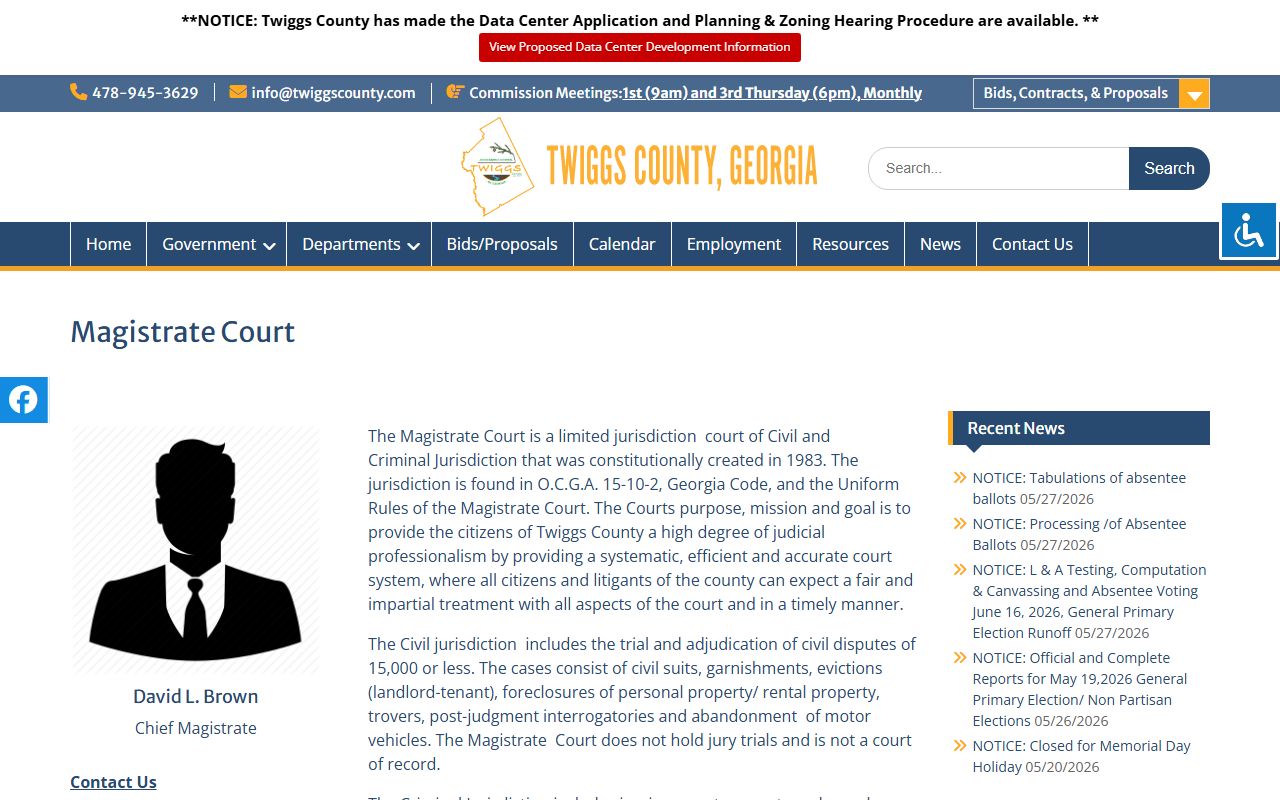
Use the Magistrate office for the early arrest-stage court context, then use the clerk and PeachCourt path when the case belongs in Superior Court.
Superior Court Arrest Records
Felony prosecutions and Superior Court criminal records in Twiggs County route through the Clerk of Superior Court and the Dublin Judicial Circuit District Attorney. The GSCCCA Twiggs Clerk listing names Karen F. Burke as Clerk of Superior Court. The clerk's office is listed at 425 Railroad Street North, P.O. Box 234, Jeffersonville, GA 31044, with phone (478) 945-3350 and fax (478) 945-6751. Hours are 9:00am to 5:00pm, Monday through Friday. The same listing names Melinda Kelley Sodowsky as the criminal contact.
Superior Court is the key court-record office when a Twiggs County jail arrest becomes a felony prosecution, when the roster shows Superior Court in the charge table, or when the reader needs a filed accusation, indictment, disposition, sentence, or later case activity. Juvenile matters also appear in the clerk listing, but juvenile records are not the same as adult public criminal dockets. Public access may be limited when records are restricted, juvenile, sealed by order, or tied to sensitive prosecution material.
| Office | Use It For | Local Detail |
|---|---|---|
| Magistrate Court | Warrants, first appearance, bond, preliminary hearings | Chief Magistrate David L. Brown, (478) 945-3428 |
| Superior Court Clerk | Superior criminal files, felony case records, filed documents | Karen F. Burke, clerk; criminal contact Melinda Kelley Sodowsky |
| District Attorney | Prosecution status after arrest and formal charge decisions | Harold McLendon, Dublin Judicial Circuit, (478) 272-0440 |
| Sheriff Records | Initial incident report and jail or arrest records | Requests beyond initial incident reports in awaiting-trial cases may require DA or discovery routing |
PeachCourt Case Access
The Georgia courts e-access directory lists Twiggs Superior under PeachCourt. The state e-access page warns that users are redirected to provider websites and that provider accounts may be required. PeachCourt's access page advertises Georgia civil and criminal e-filing and court document access, but the inspected public page did not expose Twiggs-specific case-search fields without registration or login. Because of that, Twiggs County court records after a jail arrest should not be described as a simple free anonymous name search unless a user has verified current PeachCourt access.
Start with known data from the jail roster before contacting the clerk or using PeachCourt. The most useful details are the defendant's full name, arrest date, charge description, statute, warrant number, and the court shown in the roster charge row. If the account-gated portal does not show the record, call the Superior Court clerk's criminal contact or make a written request with as much identifying detail as possible.
| Access Channel | Search or Request Detail | Limits |
|---|---|---|
| Georgia Courts e-access | Lists Twiggs Superior and sends users to a provider | Provider account may be required |
| PeachCourt | Registration or login for court document access | Public field labels were not visible without login during research |
| Superior Court Clerk | Name, case number if known, date details, charge details | Office request details, not a jail custody search |
| Magistrate Court | Warrant, first appearance, bond, preliminary hearing context | Not the long-term record office for many felony cases |
The Georgia courts e-access directory is the official route that identifies the provider channel for Twiggs Superior records.
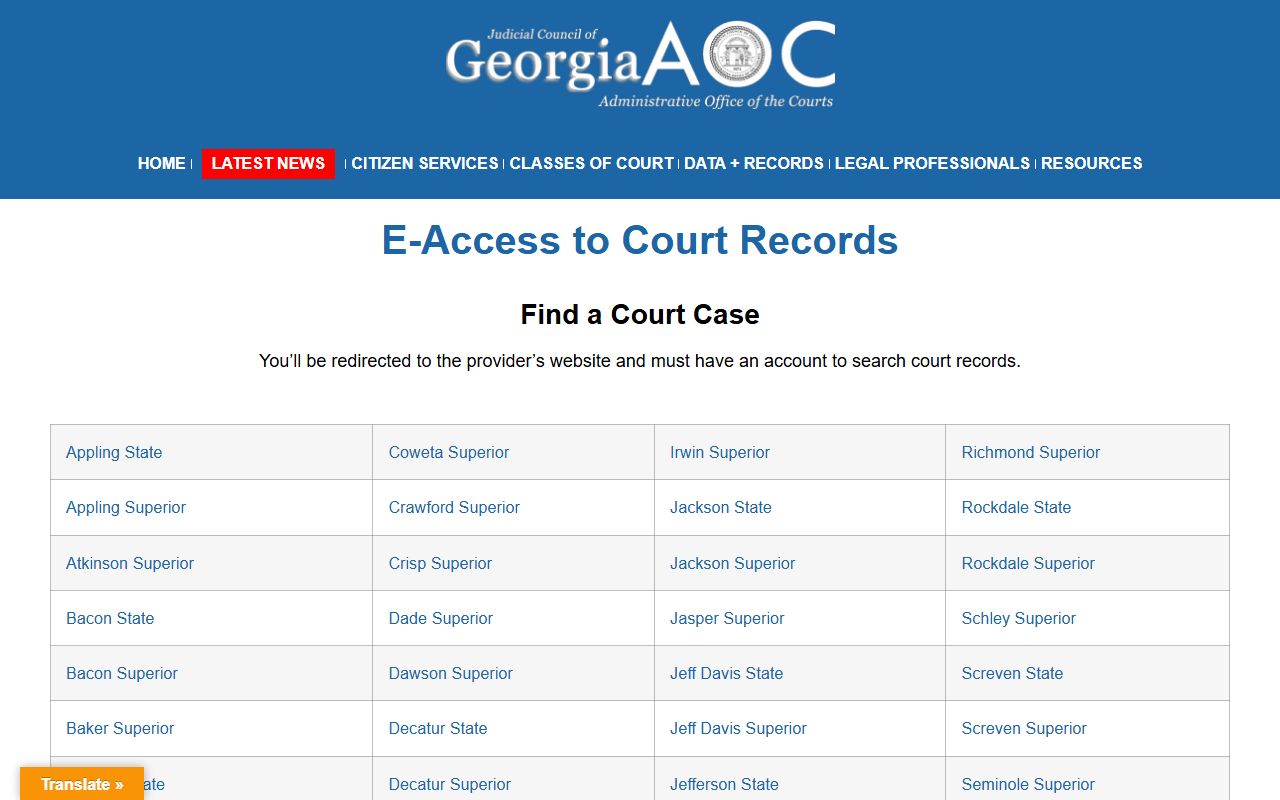
The provider listing is useful for routing, while the local clerk remains the practical fallback for older, unclear, or account-gated court records.
Charging Records After Arrest
Booking charges are not always the same charge set that moves through court. A warrant or complaint may support the arrest. The prosecutor may then file an accusation, amend the language, reduce the charge, dismiss a count, or present a felony matter to a grand jury for indictment. Twiggs County court records after a jail arrest are most reliable when the jail record is treated as the starting point and the clerk or prosecutor record is used to confirm what was formally filed.
| Document | Who Uses It | What It Means in Twiggs County |
|---|---|---|
| Complaint or warrant | Law enforcement, prosecutor, or court | Often the arrest-stage basis that can appear near Magistrate Court activity |
| Accusation | Prosecutor | A formal charging document that can move a case without grand-jury indictment where allowed |
| Indictment | Grand jury and Superior Court | A felony charging document for cases that require or use grand-jury action |
Twiggs Arrest Charge Status
A court record after a Twiggs County arrest can change more than once. The jail roster may show a statute, description, felony or misdemeanor marker, and court. The court file may later show a different formal count, a new count, or a dismissal. A charge status is not a moral finding. It is a case position at a point in time, and time-sensitive status should be verified with the clerk, the court, the District Attorney, or counsel.
| Status | Plain Meaning | Where to Verify |
|---|---|---|
| Pending | The charge is still open or awaiting the next court action. | Clerk, PeachCourt where available, or DA for prosecution status |
| Amended or reduced | The charge wording, count, or level has changed after review. | Filed court documents and prosecutor action |
| Dismissed | The charge was ended by court or prosecution action. | Clerk disposition and court order |
| Nolle prosequi | The prosecutor declined to pursue the charge at that stage. | DA and clerk records |
| Indicted | A grand jury returned a formal felony charging document. | Superior Court clerk records |
Note: A roster charge can help start the search, but the court disposition controls the final case outcome.
Bond After Twiggs Arrest
Bond in Twiggs County is closely tied to the first court steps after arrest. The sheriff FAQ says a person may have bond issued immediately after booking or within 72 hours depending on the charges. Magistrate Court has jurisdiction over first appearance and bond hearings. The roster may show a total bond amount or `NOT SET`, but a total bond field is not always a release guarantee. Holds, cash-only orders, probation or parole issues, court holds, and outside-agency holds can prevent release even when a local bond number appears.
| Bond Type | How It Works Locally |
|---|---|
| Cash bond | The sheriff FAQ says cash bond is paid by money order in the bond amount. |
| Property bond | Property bond work is handled at the sheriff's office weekdays between 9:00 and 5:00. |
| Professional bondsman | The person arranging release must contact the bonding company personally. |
| Cash-only bond | Property bond and bonding company options do not work when the court orders cash only. |
| No-bond or hold | Call Twiggs County Jail at (478) 945-2512 to confirm whether a hold blocks release. |
Warrants Before Court Records
No official Twiggs County online active-warrant search was located in the official sources reviewed. The official fallback is the sheriff's office and the issuing court. The sheriff contact page names Alma Lewis as Warrants Clerk and lists the sheriff's main number as (478) 945-3357. After a warrant leads to booking, the jail roster may show a warrant number, count, statute, charge description, felony or misdemeanor marker, and court. Those fields can point to Magistrate Court or Superior Court, but they do not replace direct court verification.
- Arrest warrant
- A court order authorizing arrest on a criminal allegation.
- Bench warrant
- A warrant often tied to failure to appear or a violation of a court order.
- Outside-agency hold
- A custody notice that another agency has an interest in the person.
- Preliminary hearing
- A Magistrate Court hearing that can test probable cause before the case moves forward.
Charge vs Conviction
An arrest, a booking photo, a jail roster charge, and a conviction are separate things. Twiggs County court records after arrest should be read with that distinction in mind. A charge is an allegation or formal count. A conviction requires a guilty plea, verdict, or other court outcome that legally resolves guilt. The Twiggs roster can help identify the starting charge and court, but the case disposition belongs in the court record.
| Point Compared | Charge | Conviction |
|---|---|---|
| Stage | Arrest, booking, warrant, accusation, or indictment stage | Final plea, verdict, or adjudicated outcome |
| Proof level | Based on allegation, probable cause, or prosecutor filing | Based on court process and proof beyond a reasonable doubt or plea |
| Where it appears | Roster charge table, warrant, court filing | Clerk disposition, sentence, criminal-history record where public |
| What to avoid | Do not treat it as guilt | Do not assume it exists unless the court record shows it |
Restricted Arrest Court Records
Georgia uses record restriction to limit public access to eligible criminal-history records. The record-restriction route is described through O.C.G.A. 35-3-37 in the GBI record-restriction guide and Georgia.gov materials. Eligible paths can depend on arrest date, case outcome, prosecutor action, and court order. For older arrests before July 1, 2013, the process can begin with the arresting agency. Later arrests often route through prosecutor and court steps.
| Term | Georgia-Focused Meaning | Public Access Effect |
|---|---|---|
| Public record | Record available unless a law, court order, or exemption limits it | May be viewable through roster, clerk, portal, or request |
| Restricted record | Georgia term for limiting access to eligible criminal-history records | May be withheld from many public searches |
| Sealed record | Court-limited access to a case file or filing | Public view may be blocked or narrowed |
| Expunged | Common public term, but Georgia generally uses record restriction language | Do not assume destruction of all records without a specific order or law |
Important: Court and jail data may not be used for employment, housing, credit, insurance, tenant screening, or other FCRA-regulated decisions.